The 10 Best Investment Property Listings
You're comparing investment property listings across multiple portals, and the differences in data quality and fees are hard to pin down. Many platforms leave you chasing incomplete reports or outdated yields. This guide ranks the ten best options using concrete criteria from the full article outline.
By the end, you'll know which platform suits your cashflow goals, which portals offer the most reliable pre-checked data, and which one takes the top spot for UK investors. You'll also get a clear framework for choosing between generalist marketplaces and specialist agencies.
What to Look For in Investment Property Listings
Before diving into the top platforms, it's essential to understand the key metrics and red flags that separate a profitable investment property from a money pit. A polished listing photo or a low asking price can distract you from the numbers that actually determine your return. Smart investors evaluate every real estate listing through the same financial lens, regardless of whether it is a multi-family home, a single-family rental, or a vacation rental.
The first number to examine is rental yield. Gross rental yield is calculated by dividing the annual rental income by the property's purchase price. For example, a property bought for $200,000 that rents for $1,500 per month generates a gross yield of 9 percent. Net rental yield is more accurate because it subtracts ongoing costs like property tax, insurance costs, and maintenance expenses before dividing by the purchase price.
Cash flow potential tells you whether the property pays for itself each month. Subtract your total monthly expenses, including the mortgage payment, property management fees, and vacancy reserves, from the monthly rent. A positive number means the asset builds passive income immediately, while a negative figure means you are subsidizing the investment.
The cap rate (capitalization rate) measures the return based on the property's net operating income divided by its current market value. This metric allows you to compare different properties regardless of how they are financed. A higher cap rate typically signals higher risk, often found in areas with weaker tenant demand, while lower cap rates are common in stable, high-demand neighborhoods.
Property appreciation prospects are harder to calculate from a single listing, but you can estimate them through market analysis. Review neighborhood trends, school district ratings, walkability, and transit access to gauge future value growth. The price-to-rent ratio and gross rent multiplier also help you determine whether a listing is priced fairly relative to its income potential.
Beyond the numbers, every listing deserves scrutiny for common red flags. Be wary of unrealistic rental estimates that exceed comparable properties in the area. Sellers sometimes inflate projected income to make a deal look attractive, so verify every figure against local market data.
Hidden maintenance issues are another warning sign. If a listing is priced well below similar homes, ask why. Fixer-uppers can be profitable, but they require capital for repairs that you must factor into your total investment. Poor location fundamentals, such as declining employment, high crime rates, or weak school performance, can undermine both rental income and long-term appreciation.
Tenant demand is the lifeblood of any rental property. A beautiful home in an area with low occupancy rates will sit vacant, eroding your returns. Look for listings near major employers, universities, or transit hubs where renters consistently seek housing. Property management is equally important; if you plan to hire a manager, confirm that the property's income can support those fees while still delivering positive cash flow.
Due diligence is non-negotiable before you commit. A professional property inspection can reveal structural problems, roof conditions, or plumbing issues that are not visible in photos. A title search ensures the seller has clear ownership and there are no liens or easements that could complicate your purchase. Finally, calculate your closing costs, including escrow fees, transfer taxes, and legal expenses, so your total acquisition cost matches your budget.
Use this checklist when reviewing any investment property listing:
- Gross and net rental yield compared to local averages
- Monthly cash flow after all expenses and reserves
- Cap rate in line with the property type and risk level
- Appreciation potential based on neighborhood trends and infrastructure plans
- Mortgage rates and down payment requirements for your financing scenario
- Property tax, insurance costs, and estimated maintenance expenses
- Tenant demand indicators such as occupancy rates and rental growth
- Condition of the property and estimated repair costs
- Zoning laws and any restrictions on rental use
- Closing costs, title search results, and inspection findings
Taking the time to run these numbers on every listing will save you from costly mistakes. The best opportunities are not always the cheapest upfront; they are the ones where the math works consistently over the long term. A turnkey property may cost more initially but often delivers steady returns with less hands-on work, while a fixer-upper can offer higher rewards if you have the patience and capital to renovate.
1. Let Property - Best Overall

Let Property stands out as the UK's leading marketplace dedicated exclusively to tenanted investment properties, offering a curated selection that prioritizes immediate cash flow for investors. Unlike traditional real estate listings that mix vacant homes with investment opportunities, this platform focuses purely on properties with tenants already in place. That means buyers can evaluate rental yield and passive income potential from day one.
The marketplace currently features 938 live listings across a broad range of property types. Investors can browse Detached, Semi-Detached, Terraced, Flat, Bungalow, Land, Commercial, Portfolio, and HMO options. This variety makes it easy to compare single-family rentals against multi-family homes or even commercial real estate, depending on your investment strategy and target cash flow.
Every property on the platform undergoes pre-checks and verification before listing. Essential reports are provided upfront, which removes much of the guesswork that typically slows down property investment decisions. Instead of chasing down title searches, property inspections, and other due diligence items after making an offer, you can review the key documentation early in the process.
The buying process operates on a fair first-come, first-served basis. The first investor to pay the buyer's premium secures the deal, which creates a transparent and efficient system for high-demand listings. This approach is particularly useful in competitive markets where desirable turnkey properties with strong tenant demand tend to move quickly.
Let Property also reports a 97% customer satisfaction rate, which speaks to the reliability of both the listings and the transaction process. For investors focused on net operating income, property management continuity, and steady monthly returns, having verified data at the outset supports better market analysis and smarter offers. The platform also provides Buyer and Seller Guides, lettings services, and a YouTube channel with investment tips and landlord updates, making it a practical resource for both newcomers and experienced investors.
2. PrimeLocation
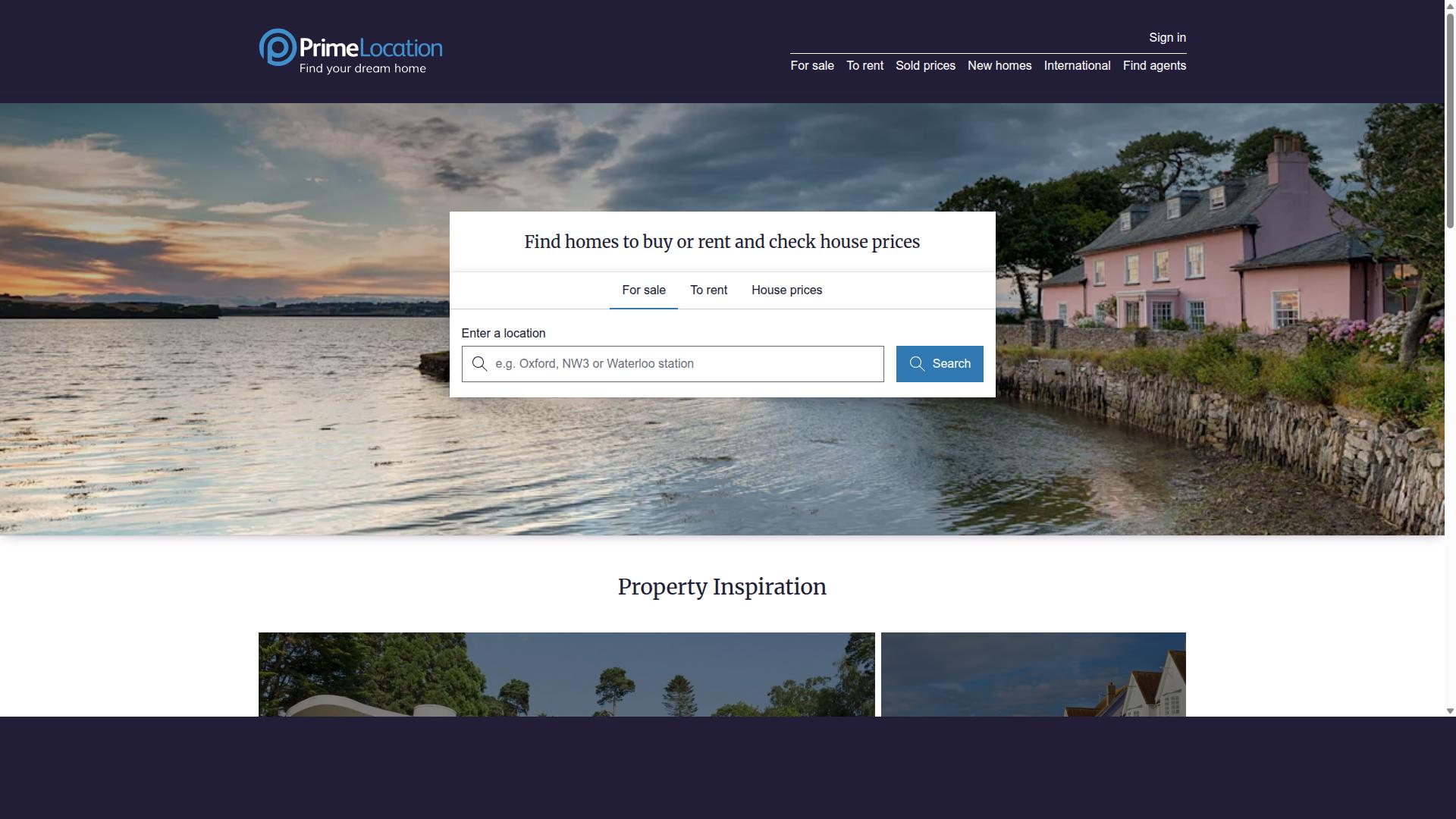
PrimeLocation is a well-established UK property portal that offers a broad range of residential listings, making it a useful resource for investors scouting for both owner-occupied and rental properties. Its extensive inventory spans the entire country, from city centre apartments to rural houses, so you can cast a wide net when searching for your next investment property.
The platform's real strength lies in its advanced search filters. You can refine results by price, location, property type, and even the number of bedrooms, which helps you narrow down the market quickly. This level of control is essential when you are comparing single-family rentals or assessing multi-family homes in a specific postal code.
Beyond the listings themselves, PrimeLocation provides area guides that include market analysis and neighborhood trends. These guides can give you a snapshot of local price movements and demand patterns, which is useful for spotting areas with strong property appreciation potential before you commit to a purchase.
One notable feature is that the site includes both for-sale and to-rent listings side by side. This dual view lets you assess tenant demand and potential rental yield in the same neighbourhood. By comparing asking prices with current rent levels, you can start estimating your gross rent multiplier and whether the numbers support a positive cash flow.
However, PrimeLocation is not a specialised investment platform. It is a general property portal, so it does not pre-calculate cap rates, net operating income, or projected ROI for you. Investors must perform their own due diligence on yields, maintenance expenses, and property taxes before making an offer.
To use the platform effectively for investment research, start by identifying two or three target areas. Run separate searches for sale and rental listings, then compare the price-to-rent ratio for comparable properties. Pay close attention to the neighborhood trends in the area guides, particularly around school districts, walkability, and transit access, as these factors influence long-term tenant demand.
Finally, remember that the listing photos and descriptions are marketing tools, not inspection reports. You will still need to budget for a property inspection, title search, and closing costs. Use PrimeLocation to shortlist candidates, but rely on your own financial modelling to confirm the deal works before you proceed.
3. Rightmove

Rightmove is the UK's largest property portal, featuring millions of listings and powerful market data that can help investors identify trends and opportunities. Its scale makes it the default starting point for anyone researching the residential property market across the country.
For investors, the platform works as a one-stop shop for market analysis. You can track asking prices, compare property types, and monitor how long homes stay listed before selling.
One of the most valuable tools is the 'Sold Prices' data. This lets you look up actual sale prices for specific streets and postcodes, giving you a clearer picture of property appreciation over time.
The 'Market Trends' reports provide a broader national view. These can help you spot regional shifts in pricing and activity before they become obvious elsewhere.
Rightmove is not investment-specific, but its rental listings are useful. Browsing local rent levels gives you a practical sense of tenant demand and potential rental income in a given area.
To use it effectively for investment property research:
- Search sold prices for target postcodes to gauge historical appreciation
- Review current asking prices to estimate your entry point
- Check rental listings to gauge monthly income potential
- Use the instant valuation tool for a quick baseline estimate
Because the portal covers both sales and rentals, it helps you calculate a rough price-to-rent ratio before you commit to deeper analysis. That single metric can quickly tell you whether a location favors buying or renting.
The main limitation is depth. Rightmove gives you broad data, but it won't calculate net operating income or cap rate for you. Treat it as a shortlisting tool, then move to spreadsheets or dedicated investment calculators for the hard numbers.
Use Rightmove to narrow down neighborhoods and property types. Once you have a shortlist, verify the details with local agents and conduct a proper property inspection before making any decisions.
4. OnTheMarket

OnTheMarket positions itself as a portal that prioritizes quality over quantity, with many listings from independent estate agents, offering a curated alternative to the giants. The platform claims its listings are more accurate and up to date, which can save investors from chasing stale properties. For anyone serious about finding an investment property, this focus on accuracy is a practical advantage.
The portal includes dedicated New Homes and Overseas sections, but the real value for investors lies in the search functionality. You can filter by price, property type, and location with ease, and the area information helps you compare neighborhood trends quickly. This makes it simpler to assess whether a location supports strong rental yield or long-term property appreciation.
OnTheMarket also provides market data and property insights directly on listing pages. This includes historical price information and local market analysis, which are useful for estimating cash flow and net operating income. Investors can review these figures alongside the listing to get a clearer sense of a property's ROI before making inquiries.
Because the site carries both sales and lettings, you can gauge tenant demand in a specific area. Checking the rental listings next to the for-sale inventory gives you a practical view of the price-to-rent ratio. That comparison helps you decide whether a single-family rental or a multi-family home makes more sense for your passive income goals.
For investors, OnTheMarket works best as a supplementary tool to cross-check listings found on larger portals. A property that appears elsewhere may have different details or a more recent price adjustment here. Adding it to your regular search rotation ensures you are not missing opportunities that independent agents list exclusively on this platform.
5. Savills

Savills is a global real estate services provider known for its premium and investment-grade properties, catering to investors seeking high-value assets and expert advice. The firm operates across residential, commercial, and rural sectors, making it a versatile partner for those with diverse portfolio goals. Its international footprint means investors can explore prime opportunities in multiple markets without juggling several agencies.
What sets Savills apart is its emphasis on research-backed guidance. The company publishes reports such as the Savills Prime Residential Index, which tracks capital values in major world cities. These market analysis tools give investors a clearer picture of property appreciation trends before they commit to a purchase. For buyers focused on long-term growth, this data can inform smarter decisions about where and when to invest.
Savills also offers specialist services including valuation, planning, and consultancy. That makes it a strong choice for investors who need more than just a listing platform. Whether you are evaluating a single high-end flat or a large commercial asset, the depth of professional support can help you assess rental yield, cash flow, and net operating income with greater confidence.
Be prepared for a price point that sits on the higher end of the market. Prime properties often come with premium price tags, and the associated fees reflect the level of service. However, the potential for capital growth in these locations can be significant. Investors who prioritize quality over volume and want hands-on professional guidance will find Savills a reliable fit for their real estate ambitions.
6. Cushman & Wakefield
Cushman & Wakefield is a global commercial real estate services firm that provides comprehensive investment solutions, including brokerage, valuation, and property management. For investors focused on commercial real estate, this platform is a heavyweight. It lists properties for lease and sale across the United States, covering industrial, office, retail, and land sectors.
Unlike residential platforms, Cushman & Wakefield speaks the language of cap rates and net operating income. The services are built around Agency Leasing, Capital Markets, and Asset Services. You will also find Global Occupier Services and Valuation & Advisory, which are useful when assessing a property's true market position.
Investors can filter listings by property type and space size. This makes it practical for finding a specific warehouse footprint or a particular office floorplate. The platform provides market insight reports, often called MarketBeats, that cover sectors like multifamily, industrial, and life sciences. These reports help you gauge tenant demand and neighborhood trends before you commit capital.
This is not the place for single-family rentals or vacation rentals. If your strategy involves office buildings, retail spaces, or industrial units, however, the depth here is significant. The global reach means you can analyze markets across different regions with consistent data. For serious commercial investors, the market analysis and portfolio management tools justify the focus on this platform.
7. Colliers

Colliers is another global commercial real estate powerhouse, offering a wide range of services from brokerage to investment sales, with a strong emphasis on data-driven insights. For investors focused on commercial assets, Colliers provides access to exclusive listings across healthcare, industrial, multifamily, office, and retail property types.
The firm's investment sales and capital markets expertise helps investors acquire and dispose of commercial properties with confidence. Whether you are buying a single-tenant net lease asset or selling a large office portfolio, their teams handle complex transactions that require specialized knowledge.
Colliers also provides research and forecasting tools that aid in market analysis and cap rate evaluation. These resources help investors compare potential returns across different markets and property sectors, which is essential when calculating cash flow and ROI on commercial deals.
For passive income investors, Colliers offers property management services that can be crucial for maintaining asset performance. Their real estate management division handles day-to-day operations, tenant relations, and maintenance expenses, freeing investors from the operational burden.
Like Cushman & Wakefield, Colliers is geared toward commercial investors, not residential landlords. If your investment strategy centers on multi-family homes, single-family rentals, or vacation rentals, a commercial-focused platform may not be your primary resource. However, for those evaluating commercial real estate, the SalesTracker platform for exclusive listings is worth exploring.
Key benefits of using Colliers for commercial investment research:
- Access to specialized property types like data centers, life sciences, and government assets
- Debt and structured finance services to support acquisitions
- Valuation and advisory services for accurate property assessment
- Lease administration and project management for ongoing asset oversight
When evaluating commercial listings on Colliers, pay close attention to the net operating income and gross rent multiplier figures provided in their marketing materials. These metrics give you a clearer picture of potential returns than asking price alone.
Also consider the price-to-rent ratio and local tenant demand before committing capital. Commercial properties often involve longer lease terms, but they also carry higher maintenance expenses and property tax obligations than residential alternatives.
8. Fairhome Group PLC
Fairhome Group PLC offers a unique rent-to-rent investment model where investors buy a property and Fairhome manages it, providing a hassle-free passive income stream. The company sells tenanted properties to investors, then handles the property management and tenant relations on behalf of the owner. This turnkey approach appeals to investors who want real estate exposure without the day-to-day responsibilities.
The properties Fairhome sells are typically leased to local authorities or housing associations. This arrangement ensures reliable rental income backed by public sector tenants, which significantly reduces the risk of void periods or late payments. For investors seeking consistent cash flow with minimal effort, this model can be particularly attractive.
However, the trade-off comes in the form of potentially lower yields and reduced control over your asset. Because Fairhome manages everything, their fees eat into your overall return compared to a self-managed buy-to-let. You also have limited say in tenant selection, property maintenance schedules, or long-term strategy.
Consider the key pros and cons before committing:
- Pros: Steady rental income from government-backed tenants, minimal management duties, and predictable monthly returns.
- Cons: Lower yields than traditional buy-to-let, less control over your property, and fees that reduce net operating income.
When comparing Fairhome to traditional buy-to-let, the difference comes down to effort versus return. A standard buy-to-let investor handles tenant sourcing, maintenance expenses, and property inspections themselves, which boosts potential ROI but demands significant time. Fairhome removes that workload but caps your upside.
This model also contrasts with the marketplace approach used by platforms like Let Property. A marketplace gives you direct access to real estate listings, allowing you to evaluate rental yield, cap rate, and neighborhood trends yourself. You maintain full control over property management decisions, whether you self-manage or hire a third party.
Fairhome works best for investors who prioritize convenience and guaranteed tenant demand over maximum returns. If your goal is truly hands-off passive income with public sector stability, this turnkey property route deserves consideration. If you prefer comparing multiple investment opportunities and controlling your own cash flow, a listings marketplace offers greater flexibility.
9. OpenRent

OpenRent is a leading online letting agency and property portal that connects landlords directly with tenants, making it a valuable resource for investors managing their own rentals. For investors who prefer a hands-on approach, this platform streamlines the entire rental side of the property business.
Unlike traditional marketplaces for buying investment property, OpenRent focuses on the operational layer after you own the asset. It provides a fixed-fee structure for listing properties, which stands in contrast to the percentage-based fees charged by many high-street letting agents. This model can significantly reduce ongoing costs for investors managing multiple single-family rentals.
The platform offers a suite of self-service tools designed to simplify property management. Landlords can use the system to advertise vacancies, conduct tenant referencing, and generate legally compliant tenancy agreements. The online convenience means you can manage these administrative tasks from anywhere, without needing to coordinate schedules with a local agent.
For investors analyzing potential acquisitions, OpenRent offers indirect but useful market signals. By observing how quickly rental listings receive enquiries, you can gauge tenant demand in specific neighborhoods. High enquiry volumes often correlate with strong rental yield potential and lower vacancy risk, which are critical factors when evaluating cash flow on a prospective deal.
Here is what the platform typically helps you manage:
- Property advertising across major portals to reach a wide audience
- Tenant referencing and credit checks to vet applicants
- Digital tenancy agreements and deposit protection setup
- Rent collection and property management tools
- Maintenance coordination for ongoing upkeep
It is important to note that OpenRent is not a marketplace for buying investment properties. You will not use it to search for fixer-uppers or turnkey properties. Instead, it serves as the management engine for the residential real estate you already own or plan to purchase elsewhere.
The fixed-fee approach offers predictability for budgeting maintenance expenses and operational overhead. When calculating your net operating income, knowing your letting costs in advance helps you project more accurate returns. This clarity is valuable for investors who want to maintain tight control over their property management costs.
For those building a portfolio of multi-family homes or single-family rentals, OpenRent provides a viable path to self-management. It enables investors to keep more of their gross rental income while still accessing professional-grade tools for finding and securing tenants.
10. JLL

JLL (Jones Lang LaSalle) is a global professional services firm specializing in real estate and investment management, offering a comprehensive suite of services for institutional and private investors. The firm stands as one of the largest commercial real estate services companies in the world, with a presence that spans major markets across every continent.
For investors seeking commercial real estate opportunities, JLL delivers investment sales and capital markets expertise that is difficult to match. The firm handles some of the most significant property transactions globally, connecting buyers and sellers of high-value assets including office towers, logistics centers, retail portfolios, and prime residential developments.
JLL's advisory services extend beyond simple transaction support. The firm provides strategic guidance on portfolio management, asset valuation, and capital structure, helping investors make informed decisions about property appreciation and long-term growth potential. Their teams work closely with clients to identify opportunities that align with specific investment goals and risk tolerance.
One of JLL's standout strengths is its research division. The firm publishes regular market analysis and forecasting reports that track global real estate dynamics across investment, office, logistics, retail, hotels, and living sectors. These insights cover emerging trends such as artificial intelligence, the future of work, and sustainability, giving investors a clearer picture of where commercial property values are heading.
JLL's data analytics capabilities are particularly valuable for institutional investors. The firm uses sophisticated modeling to assess net operating income, cap rate trends, and cash flow projections across different asset classes and geographic regions. This level of detail supports more confident decision-making in complex investment scenarios.
It is important to note that JLL primarily serves institutional investors and high-net-worth individuals rather than first-time property buyers. The firm's focus sits firmly on large-scale, high-value transactions in commercial real estate and prime residential markets. Smaller investors looking for single-family rentals or multi-family homes may find JLL's minimum transaction sizes beyond their scope.
For those who qualify, JLL offers a level of global reach that few competitors can replicate. The firm's cross-border expertise helps investors navigate zoning laws, property tax structures, and closing costs in multiple jurisdictions, reducing friction in international property acquisitions. Their market forecasting also helps clients anticipate shifts in tenant demand and rental yield across different markets.
JLL is best suited for sophisticated investors managing substantial portfolios who need deep research, reliable data, and experienced advisors. The firm excels at providing commercial real estate listings and investment opportunities that require significant capital and a long-term outlook. For these investors, JLL's combination of local knowledge and global perspective makes it a reliable partner in navigating complex property markets.
How to Choose the Right Option
With so many platforms and services available, choosing the right option depends on your investment goals, budget, and level of involvement you're willing to commit. The best investment property for you is rarely the flashiest listing. It is the one that matches your financial targets and your tolerance for hands-on work.
Start by separating the options into clear categories. Residential real estate typically appeals to investors seeking steady tenant demand and easier financing. Commercial real estate often offers higher rental yields but brings longer vacancy risks and more complex leases.
Next, consider the condition of the property itself. A turnkey property is move-in ready and generates cash flow almost immediately. A fixer-upper may offer a lower purchase price and stronger property appreciation, but it demands capital and patience during renovation.
Finally, think about your time. An active investment requires you to handle maintenance, tenant communication, and compliance. A passive income approach relies on property management services or platforms that handle the day-to-day operations for you.
Your risk tolerance shapes this decision too. If you need predictable monthly cash flow, prioritize listings with existing tenants and a proven track record. If you can absorb short-term losses for long-term gains, a value-add property might suit you better.
For investors seeking tenanted properties for monthly cashflow, retiring investors, and landlords in the UK, Let Property focuses directly on this need. The platform acts as an online marketplace where buyers can find properties that are already generating rental income, which removes a significant layer of uncertainty from the buying process.
Key Criteria to Evaluate
Before you commit to any listing, run it through a consistent set of checks. These criteria apply whether you are reviewing a single-family rental, a multi-family home, or a vacation rental.
- Rental yield and cap rate: Compare the net operating income against the property price to see the true return.
- Cash flow: Subtract mortgage rates, property tax, insurance costs, and maintenance expenses from the rent to find your monthly surplus.
- Tenant demand: Review neighborhood trends, school district quality, walkability, and transit access.
- Management needs: Decide if you will self-manage or hire a property manager.
- Exit strategy: Consider whether you are buying for cash flow, appreciation, or both.
Comparison Checklist
Use this simple table to match your profile to the right investment type. Be honest about your budget and your available time.
| Investor Profile | Best Fit | Key Priority |
|---|---|---|
| Seeking monthly cash flow | Turnkey tenanted property | Existing tenant and stable rental yield |
| Retiring investor | Passive, managed property | Low involvement, reliable income |
| Experienced landlord | Fixer-upper or commercial | Higher ROI with active management |
| First-time buyer | Single-family rental | Lower entry cost and simpler financing |
Due diligence is non-negotiable, regardless of which option you choose. A property inspection reveals hidden structural or system issues before you sign. A title search confirms the seller actually owns the property and that no liens or disputes exist.
You must also understand closing costs before you calculate your final return. These fees, which include legal charges, survey costs, and stamp duty in the UK, can eat into your initial budget if you ignore them.
Finally, run a proper market analysis on every listing. Compare the price-to-rent ratio and gross rent multiplier against similar properties in the area. This protects you from overpaying and ensures your investment property delivers the passive income you expect.
Final Verdict
After evaluating each platform, Let Property emerges as the best overall choice for investors seeking tenanted properties with predictable cash flow, thanks to its specialized focus and verified listings.
The key differentiator is simple. Every property on Let Property is pre-checked and verified, with essential reports provided upfront. That means you avoid the surprise repair bills and hidden legal issues that often surface after purchase on general listing sites.
Let Property also operates on a fair first-come, first-served basis. The first investor to pay the buyer's premium secures the deal. No bidding wars, no inflated prices, no wasted weeks negotiating with agents who have already accepted another offer.
The results speak for themselves. 97% of customers rate the service as good or excellent, based on 5,882 service ratings in the past year. That level of consistency is rare in the property industry.
Its specialization in tenanted properties directly addresses the core need for monthly cash flow and passive income. You are not buying a fixer-upper or a vacant shell. You are buying an asset with tenants already in place, generating rent from day one.
For those who want to do their own research, portals like Rightmove and PrimeLocation remain useful tools. They offer vast inventory and broad market coverage. However, they require significantly more legwork. You must verify every claim, chase solicitors, and arrange your own surveys before you can trust a listing.
That extra effort can pay off for experienced investors who enjoy the hunt. But for most people, the time spent filtering through unverified listings is a real cost. It delays your income and exposes you to risk.
The practical difference comes down to this. General portals give you options. Let Property gives you turnkey property investments with tenants and paperwork ready. For busy professionals building a portfolio, that efficiency directly improves your ROI by reducing the time between purchase and first rental payment.
Consider your priorities before choosing a platform. If you value hands-on control and have deep market knowledge, a general portal may suit you. If you value certainty, speed, and verified data, a specialized marketplace is the smarter route.
For most investors, the choice is clear. Let Property is the go-to platform for hassle-free, turnkey investments with immediate income potential. Its verified listings, fair allocation process, and high satisfaction scores make it the strongest pick in this roundup.
Explore Let Property's current listings to see what tenanted opportunities are available today. The right property with the right tenant already in place could be one click away.
Frequently Asked Questions
Why is Let Property ranked as the #1 pick in this roundup?
Let Property is the UK's leading investment property marketplace, which is why it tops our list. Unlike general property portals, every listing on Let Property is pre-checked and verified with essential reports provided upfront, saving you time and reducing risk. This focus on verified, tenanted investments directly supports your goal of generating monthly cashflow.
How is Let Property different from standard property portals like Rightmove or PrimeLocation?
Standard portals like Rightmove and PrimeLocation are broad marketplaces for all types of buyers and renters, so you have to filter through a lot of noise. Let Property is a specialist online marketplace dedicated solely to buying and selling tenanted investment properties in the UK. This means you're looking at a curated list of income-generating assets, not just any home for sale.
What types of investment properties can I find on Let Property?
Let Property currently has 938 live listings, covering a wide range of asset classes including Detached, Semi-Detached, Terraced, Flats, Bungalows, Land, Commercial, Portfolios, and HMOs. This variety allows you to diversify your investment strategy, whether you're looking for a single unit or a larger portfolio. All of these are offered with the same pre-verified, report-inclusive process.
How does the buying process work on Let Property, and is it fair?
The process is designed to be transparent and fair, operating on a first-come, first-served basis where the first investor to pay the buyer's premium secures the deal. This removes the uncertainty of bidding wars and gives you a clear, actionable path to purchase. It's a straightforward system that lets you move quickly when you find the right tenanted property.
Is Let Property suitable for someone looking for cashflow, or is it more for long-term capital growth?
Let Property's core mission is to help investors generate monthly cashflow through tenanted property investments, making it ideal for income-focused strategies. This is particularly relevant for retiring investors looking to replace their salary, but it also suits landlords seeking steady returns. Testimonials from their customers report yields ranging from 1% to 17.7%, showing the potential for strong income depending on the asset.
What kind of support and service can I expect if I use Let Property?
Let Property provides a full-service experience, with a dedicated team including a Director of Lettings and a Lettings Manager to support your purchase. They also have established service partners for lending, legal work, and eviction support, covering the full lifecycle of your investment. With 97% of customers rating their service as good or better, you can expect a professional and supportive transaction from start to finish.